
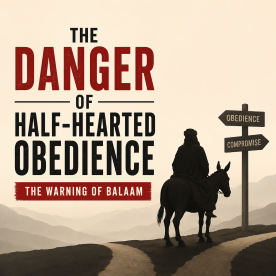
We live in a world that loves shortcuts. We look for life hacks, financial loopholes, and ways to get the maximum reward with the absolute minimum effort. Unfortunately, many of us try to bring that same “loophole mentality” into our spiritual lives. We try to bargain with God, searching for a compromise where we can keep our worldly ambitions while pretending to follow His will.
The story of Balaam, found in Numbers 22–24, serves as a timeless, urgent warning against this exact mindset. It shows us how a person can have immense spiritual privilege, speak the right religious words, and still end up entirely ruined by a divided heart.
1. The Trap of “Seeking Another Answer”
The narrative begins with Israel camping on the plains of Moab. Terrified by their numbers, Balak, the king of Moab, sends a wealthy delegation to hire a prominent prophet named Balaam to place a spiritual curse on God’s people.
When the messengers arrive with a massive financial reward, Balaam goes to God in prayer. God’s response is unambiguous:
“You must not go with them. You must not curse these people, because they are blessed.” (Numbers 22:12)
Balaam sends the messengers away. But King Balak doesn’t give up easily; he sends a second, more influential delegation, promising even greater honor, power, and wealth.
This is where Balaam’s heart reveals itself. A man fully committed to God would have rejected the offer immediately because God had already spoken. Instead, Balaam tells them to stay the night so he can see “what else the Lord will tell me.”
The Lesson: When we already know what God’s Word says about a situation—whether it’s regarding our integrity, our relationships, or our finances—but we keep praying for a “different” answer, we aren’t seeking God’s guidance. We are looking for a loophole. We are trying to find a way to make God validate our hidden desires.
2. Blinded by Ambition
Because Balaam insists, God allows him to go, but with a strict condition: he must only say what God tells him to say. As Balaam rides his donkey toward Moab, the text tells us God’s anger burns because Balaam is going with a compromised heart.
The Angel of the Lord stands in the road with a drawn sword to kill him, but Balaam is completely blind to the spiritual reality in front of him. Ironically, his donkey sees the danger and swerves into a field to save his life. Furious that his progress is being blocked, Balaam beats the animal.
This happens three times until God miraculously opens the donkey’s mouth to speak, followed by opening Balaam’s eyes to see the terrifying judgment standing right before him.
       Balaam's Internal Conflict
┌───────────────────────────────────────┐
│     Desire for Earthly Reward         │ ──► Blinds him to spiritual reality
└───────────────────────────────────────┘
                   │
                   ▼
┌───────────────────────────────────────┐
│   Superficial, Outward Compliance     │ ──► "I will only speak what God says"
└───────────────────────────────────────┘
                   │
                   ▼
┌───────────────────────────────────────┐
│     Hidden Motive of Compromise       │ ──► Leads to eventual ruin
└───────────────────────────────────────┘
Balaam fell into the ultimate spiritual irony: he claimed to be a seer who could look into the mind of God, yet he possessed less spiritual discernment than the beast he was riding. His obsession with the king’s reward had blinded him to the edge of destruction.
3. The Danger of “I Have Sinned” Without Change
When Balaam finally sees the Angel with the drawn sword, he falls on his face and utters the words, “I have sinned.”
On the surface, this looks like repentance. But true repentance means a change of mind and direction. Balaam’s confession was driven entirely by the terror of immediate judgment, not a genuine hatred of his own greed. He continues on his journey to meet Balak, still hoping there might be a way to get his hands on that wealth.
When he arrives, God compels Balaam to bless Israel three distinct times instead of cursing them. Every time he opens his mouth, prophetic blessings pour out. He even utters the beautiful wish: “Let me die the death of the righteous, and let my last end be like his!” (Numbers 23:10).
But a pious wish cannot save a compromised life.
4. The “Teaching of Balaam”: The Backdoor Strategy
While Balaam couldn’t curse Israel directly because God blocked his mouth, the New Testament pulls back the curtain on what happened next. Realizing he couldn’t collect his pay by cursing Israel from the outside, Balaam showed King Balak how to destroy them from the inside.
He advised the Moabites to send their women into the Israelite camp to seduce the men into sexual immorality and idolatry (Numbers 25, Revelation 2:14). It worked. Israel brought judgment upon themselves because they let down their guard.
Balaam thought he outsmarted God by maintaining outward compliance while secretly facilitating evil. But your hidden motives will always catch up to you. Ultimately, when Israel went to war against the Midianites, Balaam was found fighting on the side of God’s enemies and was slain by the sword.
The Ultimate Takeaway
Balaam’s life leaves us with three profound warnings:
-
Conscience is easily trifled with: If you feed a sinful desire long enough, you will eventually convince yourself that what you are doing is perfectly fine.
-
Outward religion cannot mask a divided heart: You can speak prophetic words, go to church, and use the right vocabulary, but God looks directly at the baseline motives of the heart.
-
Satan wins through compromise, not just open rebellion: The enemy rarely asks you to completely abandon your faith overnight. He simply asks you to make space for a little bit of compromise, a small open door, or a single hidden idol.
If you are currently trying to bargain with God over something you know He has called you to lay down, take a step back. True peace doesn’t come from finding a loophole; it comes from wholehearted surrender.